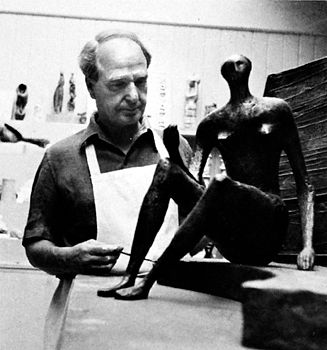
# Unveiling the Master: Henry Moore’s Enduring Legacy in Stone and Bronze!
The world of art is replete with names that echo through centuries, but few resonate with the profound, tactile power of Henry Moore. A titan of 20th-century sculpture, Moore’s organically inspired, often monumental works have fundamentally reshaped our understanding of form and space. His distinctive “hole” sculptures, frequently exploring the human figure in repose, are instantly recognizable, embodying a unique blend of abstraction and profound humanism that continues to captivate audiences globally.
Born in Yorkshire, England, in 1898, Henry Moore’s journey from a miner’s son to an internationally acclaimed artist is a testament to his unwavering dedication and singular vision. His early exposure to the rugged Yorkshire landscape, with its rolling hills and ancient rock formations, profoundly influenced his artistic language, imbuing his sculptures with a sense of timelessness and elemental strength. This connection to the natural world became a cornerstone of his practice, informing his decision to explore materials like stone and bronze, which he masterfully manipulated to evoke organic, flowing shapes. Moore’s artistic development was significantly shaped by his experiences, including his service in World War I and his subsequent studies at the Royal College of Art in London, where he began to forge his unique sculptural style. His exposure to pre-Columbian art, particularly the Mayan Chac Mool figures, also proved pivotal, inspiring his iconic reclining figures that are both monumental and intimately human.
| Category | Information |
| :——————– | :—————————————————————————————————————————————————————————————————— |
| **Full Name** | Henry Spencer Moore |
| **Born** | July 30, 1898, Castleford, West Riding of Yorkshire, England |
| **Died** | August 31, 1986, Much Hadham, Hertfordshire, England |
| **Nationality** | British |
| **Artistic Movement** | Modernism, Surrealism (influenced), Abstract Art |
| **Notable Works** | *Reclining Figure* series, *Mother and Child* series, *King and Queen*, *Nuclear Energy* |
| **Education** | Leeds School of Art, Royal College of Art, London |
| **Awards & Honors** | Companion of Honour (1953), Order of Merit (1963), numerous international accolades. |
| **Artistic Style** | Characterized by organic forms, simplified human figures, exploration of negative space (holes), monumental scale, and a deep connection to nature. |
| **Materials Used** | Bronze, stone (marble, travertine), wood, concrete |
| **Legacy** | One of the foremost sculptors of the 20th century, whose work profoundly influenced the development of modern sculpture. His pieces are celebrated for their universal themes and enduring aesthetic appeal. |
| **Official Website** | [Henry Moore Foundation](https://www.henry-moore.org/) |
Moore’s artistic philosophy centered on the idea that sculpture should possess elemental truth, mirroring the organic forms found in nature. He famously stated, “The vital thing is that the artist must have a vital connection with the human figure. Even if he abstracts it, even if he distorts it, he must have this understanding.” This philosophy is vividly demonstrated in his numerous *Reclining Figure* sculptures, where the human form is rendered with a powerful, almost geological presence. These works, often sprawling across vast spaces, invite contemplation, their smooth, undulating surfaces and deliberate voids creating a dynamic interplay between solid mass and empty space. By integrating insights from nature and his deep understanding of human anatomy, Moore achieved a remarkable synthesis that continues to inspire.
The impact of Henry Moore’s work extends far beyond the gallery walls. His public commissions grace cityscapes and landscapes across the globe, from the UNESCO headquarters in Paris to the Lincoln Center in New York. These imposing yet graceful structures serve as powerful reminders of humanity’s connection to the earth and the enduring power of artistic expression. Art critics and historians consistently laud Moore’s ability to imbue his abstract forms with profound emotional resonance, making his sculptures accessible and deeply moving. His influence can be seen in the works of countless contemporary artists who have embraced his bold experimentation with form and material.
Furthermore, Moore’s dedication to making art accessible to the public was unwavering. He established the Henry Moore Foundation in 1977, ensuring that his legacy and the promotion of sculpture would continue for generations. This forward-thinking initiative underscores his belief that art has the power to enrich lives and foster a deeper appreciation for the world around us. His prolific output and relentless innovation have cemented his status as a pivotal figure in art history, a true visionary whose sculptures continue to speak volumes about the human condition and our place within the natural world. His enduring appeal lies in this powerful confluence of the ancient and the modern, the human and the elemental, making Henry Moore a name that crossword enthusiasts and art lovers alike will continue to puzzle over and celebrate.